Allowable business expenses you might be missing in 2026/27
Quick Answer
Allowable business expenses are costs you can deduct from your income before tax, as long as they are incurred wholly and exclusively for business purposes. For 2026/27, the most commonly missed expenses include working-from-home costs, business mileage, training, professional subscriptions, pre-trading expenses, mobile phone bills and use-of-home flat-rate allowances. Claiming everything you are entitled to can reduce your tax bill significantly without any aggressive planning.
Most small business owners we meet are paying more tax than they need to, not because they are doing anything wrong but because they have never been shown what is claimable. The rules around allowable expenses are not designed to catch you out. They are designed to make sure you only pay tax on your actual profit. This guide walks through the expenses we see underclaimed every January at Nava Accountancy, with the 2026/27 rates and rules so you can use it as a checklist for your next return.
What counts as an allowable business expense in the UK?
HMRC’s test is straightforward in principle: an expense is allowable if it is incurred “wholly and exclusively” for the purposes of your trade. If a cost has both a business and a personal element, you can usually claim the business portion as long as you can identify it fairly.
This applies to sole traders, partnerships and limited companies, although the mechanics differ. Sole traders deduct expenses on their Self Assessment return. Limited companies put expenses through the company’s profit and loss account, which reduces Corporation Tax. Some costs paid personally by directors can be reimbursed by the company, and some are taxed as a benefit in kind even when business related.
The principle to hold onto is simple. If a cost is genuinely for the business, document it, keep the receipt, and claim it. If it is mixed, split it honestly. If it is personal, leave it out.
What home office expenses can I claim if I work from home?
If you run your business from home, you can claim a share of your household running costs. There are two routes.
The simplified expenses flat rate, available to sole traders and partnerships, lets you claim £10 per month for 25 to 50 hours of work from home, £18 per month for 51 to 100 hours, and £26 per month for 101 hours or more. No calculations, no receipts, no scrutiny.
The actual costs method usually claims more if you genuinely use a room for business. You take your total household costs (heating, lighting, broadband, council tax, mortgage interest or rent, insurance, water, repairs to the work area) and apportion them by room and by usage time. A typical fair split for someone using one room out of six rooms for 80% of working hours might come out at 12% to 15% of household running costs.
For limited company directors, the rules are tighter. You cannot apportion mortgage interest or council tax to the company without creating a benefit in kind. Most directors use HMRC’s allowance of £6 per week (£312 per year) without receipts, or set up a formal rental agreement between themselves and the company to claim more, which needs proper paperwork and self-assessment treatment of the rental income.
How do I claim business mileage and vehicle costs?
If you use your own car for business journeys, you can claim mileage at HMRC’s approved rates (gov.uk: travel expenses):
- 45p per mile for the first 10,000 business miles in the tax year
- 25p per mile after that
- 24p per mile for motorcycles
- 20p per mile for cycles
If you carry a business passenger on the same journey, you can add 5p per mile per passenger. Keep a simple mileage log: date, journey purpose, start and end postcode, and miles. A free phone app handles this fine.
Commuting between your home and your normal place of work is not allowable. Travel from your normal workplace to a client, or from home to a temporary workplace, is. The distinction matters.
Alternatively, sole traders can claim actual running costs (fuel, insurance, servicing, MOT, road tax, depreciation) and apportion them by business mileage percentage. This usually works out lower than the per-mile rate unless you have a particularly expensive vehicle.
What expenses are commonly missed by small businesses?
These are the ones we routinely add to client returns when we take over from a previous accountant or DIY bookkeeping:
- Pre-trading expenses: costs you incurred up to seven years before you started trading, for the purposes of the business, can be claimed in your first year. Equipment, training, market research, professional fees, all eligible if properly documented
- Professional subscriptions: membership of trade or professional bodies relevant to your work. ICAEW, CIMA, RICS, and many smaller industry associations are on HMRC’s approved list
- Training that maintains or updates existing skills: allowable. Training that gives you a new skill or qualification (rather than updating an existing one) generally is not, although for limited companies the rules are slightly more generous
- Mobile phone: a contract in the company’s name is fully claimable for limited companies with no benefit in kind, even if there is some personal use. Sole traders apportion by business use
- Software and subscriptions: accounting software, design tools, project management, cloud storage, web hosting, domain names, all standard allowable
- Bank charges and interest on business accounts and loans: claimable, often forgotten
- Use of home flat rate: see above. Often skipped because it feels small, but £312 a year times multiple tax years adds up
- Business insurance: public liability, professional indemnity, employer’s liability, cyber, all allowable
- Eye tests and prescription glasses for screen use: limited companies can pay for an eye test for a director who uses a screen as part of their duties, with no benefit in kind. Glasses are claimable only if specifically for screen use
- Christmas party or annual event: limited companies can spend up to £150 per head per year on staff annual events with no tax cost. Often missed entirely by directors who think it has to be a big firm to qualify
What about clothing, food and entertaining?
These three are the most commonly misclaimed. The rules are tight.
Clothing: only specific protective clothing or branded uniforms count. A suit you wear to client meetings is not allowable, however much you only wear it for work, because it is “dual purpose” (warmth, decency, business image). The classic case law on this is unforgiving.
Food and drink: only allowable when you are travelling away from your normal place of work on business, and the cost is reasonable. Day-to-day lunches at your desk are not claimable, even if you are working through them. Subsistence on overnight business travel is fine, with receipts.
Client entertaining: not allowable for tax purposes for any business. You can pay for it through the company, but it does not reduce your tax bill. Staff entertaining is different and has its own rules (see the £150 per head annual event allowance above).
Getting these three right makes the difference between an expenses claim that stands up to scrutiny and one that invites questions.
How long do I need to keep my expense records?
Sole traders must keep records for at least five years after the 31 January submission deadline of the relevant tax year. So records for the 2026/27 tax year (filing deadline 31 January 2028) must be kept until 31 January 2033.
Limited companies must keep records for at least six years from the end of the accounting period.
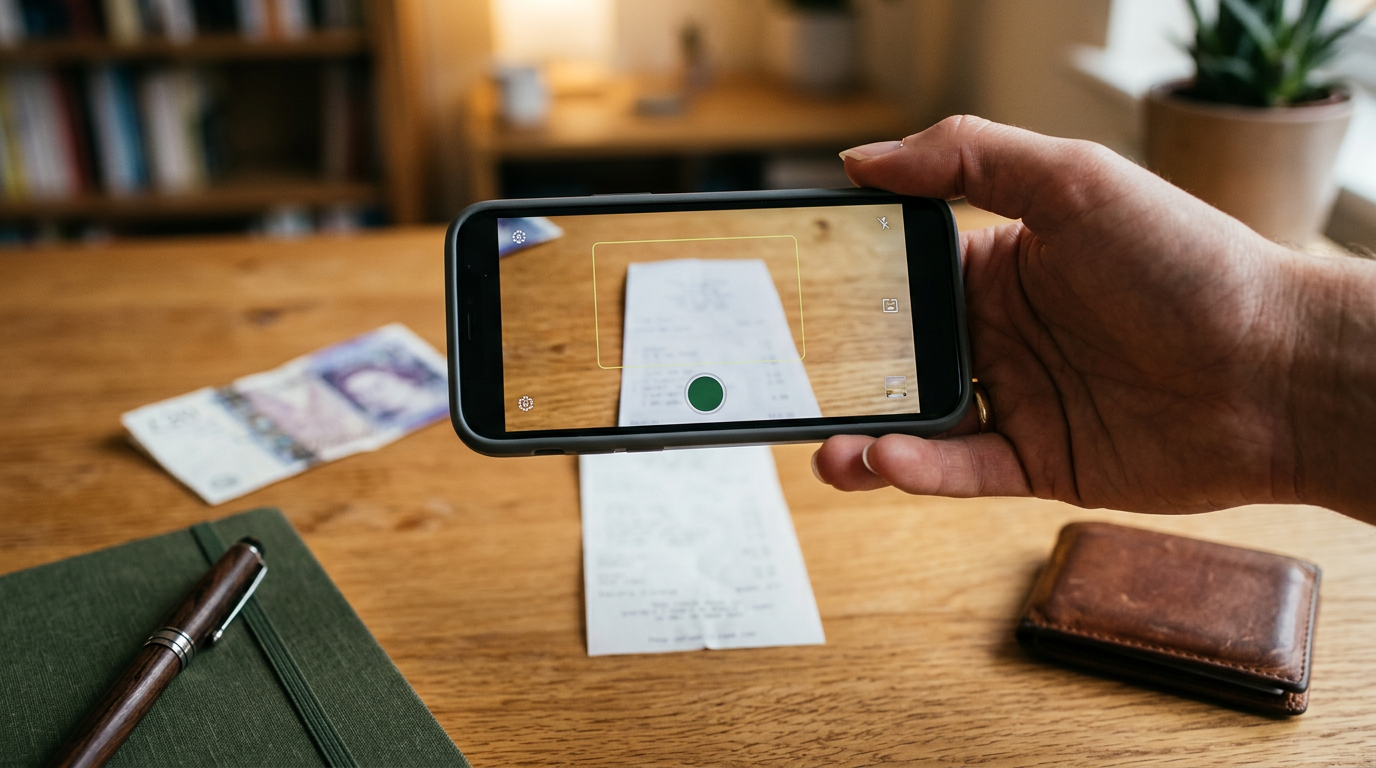
HMRC accepts digital copies, so you do not need a shoebox of paper receipts. Most accounting software, including Xero, FreeAgent, QuickBooks, Dext and Hubdoc, lets you photograph a receipt and attach it to the expense automatically. This is now the standard approach, and from April 2026 it is more or less required for sole traders earning over £50,000 because of Making Tax Digital for Income Tax Self Assessment.
What is the trading allowance and should I use it?
The trading allowance is a £1,000 tax-free allowance for trading or miscellaneous income. If your annual gross self-employment income is under £1,000, you do not need to register or report it. If it is over £1,000, you can choose either to deduct your actual expenses or to claim the £1,000 allowance, whichever gives the better result.
The allowance is most useful for very small side businesses with low overheads. As soon as your real expenses pass £1,000 a year, claim them instead. You cannot do both.
What records and software make claiming expenses easier?
The single biggest improvement most small businesses can make is to capture expenses at the moment they happen rather than once a quarter from a pile of receipts. Modern accounting software paired with a receipt-capture app means you take a photo on your phone, the OCR reads the date, supplier and amount, and the expense is in your books in 20 seconds.
For sole traders we usually recommend FreeAgent or QuickBooks. For limited companies, Xero is the most flexible. All three are MTD-compliant, all three offer free receipt capture and all three integrate with business bank feeds so reconciliation takes minutes rather than hours.
If you would like a second pair of eyes on what you are currently claiming, or you suspect you are leaving money on the table, get in touch. We work with sole traders, limited companies and growing businesses across Rossendale, Bacup, Rawtenstall, Haslingden and the wider Lancashire and UK area to make sure every legitimate expense is captured, every relief is claimed, and your tax bill reflects your real profit, not an inflated version of it. Book a free discovery call through our contact page.
Frequently asked questions
Can I claim expenses I paid for before my business started?
Yes. Pre-trading expenses incurred up to seven years before you started trading can be claimed in your first year of business, as long as they would have been allowable had you been trading at the time. Common examples include equipment, training relevant to your trade, market research and professional fees.
Can I claim a laptop or equipment as an expense?
Yes. For sole traders using cash basis accounting, equipment costs are fully deductible in the year of purchase. For limited companies and traditional accounting, equipment is usually claimed through capital allowances, with the Annual Investment Allowance covering up to £1 million of qualifying expenditure per year. Either way, business equipment is allowable.
Are accountancy fees an allowable business expense?
Yes. Accountancy and bookkeeping fees for preparing your business accounts and tax returns are allowable. Fees for personal tax advice unrelated to your business are not.
Can I claim my broadband bill as a business expense?
Sole traders can claim a fair business-use percentage of a residential broadband contract. Limited company directors can have a contract in the company’s name, used for business with some incidental personal use, with no benefit in kind. A residential contract paid by the company in the director’s name would create a benefit in kind, so most directors structure this carefully.
Do you help businesses in Rossendale and Lancashire claim the right expenses?
Yes. We work with sole traders, partnerships and limited companies in Rossendale, Bacup, Rawtenstall, Haslingden and across Lancashire and the UK to make sure every allowable expense is claimed, your accounting software is set up properly for receipt capture, and your tax position is as efficient as the rules allow. Get in touch for a free discovery call.